Showing posts with label Limit. Show all posts
Friday, April 26, 2013
Wednesday, April 24, 2013
Monday, April 8, 2013
Improper Integrals
By inspection we can see that this integral will have serious problems. Even before taking limits we notice that the limits of integration coincide with undefined values of the integrand.
I you need help with math, I can help you. Visit my mobile website: www.mathhelp.mobi
or email me at services@mathhelp.mobi
Friday, April 5, 2013
Limit of a radical expression
We multiply by the conjugate of an expression quite often - typically when we expect that it will help us remove an unwanted radical from the denominator, or in this case an unwanted expression from the denominator. This example skips a step or two here and there but I hope that it's still clear.
I you need help with math, I can help you. Visit my mobile website: www.mathhelp.mobi
or email me at services@mathhelp.mobi
Friday, March 29, 2013
Limit Definition of Derivatives
Use the definition of derivatives to find the derivative of sqrt(x)
Solution:
Multiplying by a conjugate can be a useful strategy and it helps in this problem. We also notice that sqrt(2) is only defined for real numbers greater than or equal to 0 (for calculus). This means the absolute value of an expression is also greater than or equal to 0. In the denominator we must be careful not to multiply because factoring out the delta-x is easier.
Saturday, March 23, 2013
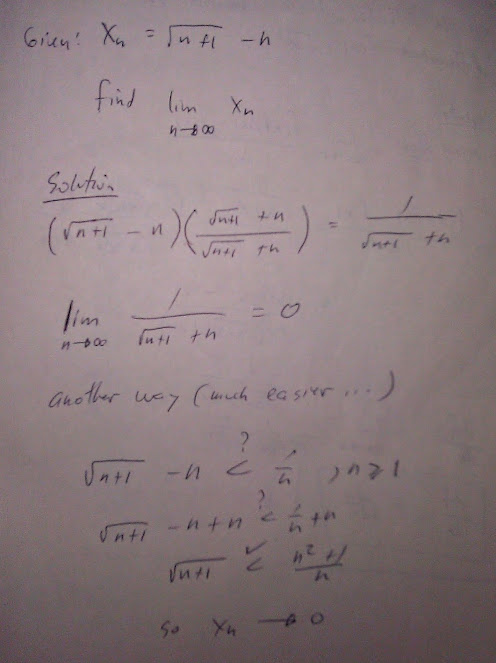
Limit of a sequence
Limit of a sequence. We us the handy strategy of re-writing the limit in a more convenient way that does not change it's value. And by using the conjugate of the expression, we are able so simplify. Alternately we can apply the direct comparison test. 1/n is a sequence that we know converges, so we compare our sequence to it. After some algebra, we can see that the inequality will hold.

Subscribe to:
Posts (Atom)


